
Agentic Harness for Go teams
Build agent systems on an explicit Agentic Harness.
MOSS Agents gives engineering teams a runtime-first harness with a reusable kernel, structured runtime assembly, and ready-to-run surfaces for coding, research, and workflow products in Go.
Overview
Runtime boundaries first. Harness surfaces second.
MOSS Agents is structured so teams can evaluate and extend each layer of the Agentic Harness without inheriting one monolithic agent stack.
Composable runtime foundation
The kernel keeps core runtime primitives small, reusable, and easier to reason about.
Extensible capability loading
appkit/runtime wires builtin tools, MCP, prompt skills, delegated agents, memory, and context into one assembly path.
Trust-aware execution
Profiles, trust, approval, workspace rules, and execution posture stay visible instead of being buried in product glue.
Stateful workflows
Session, checkpoint, task, memory, and planning paths support longer-lived agent behavior beyond one-shot prompts.
App surfaces and examples
apps and examples prove the runtime in real coding, research, writing, and orchestration workflows.
Runtime before product lock-in
Teams can start from shipped surfaces, then move inward to appkit or presets as they need deeper control.
Workflow
Start with a surface, then open the harness.
MOSS Agents is designed so evaluation can begin from something runnable and become more composable as your team goes deeper into the harness.
Run a real surface
Start with mosscode to see the most complete interactive product surface in the repository.
Open mosscodeBuild with appkit
Move to BuildKernel or BuildKernelWithExtensions when you want the runtime without inheriting the whole product shell.
Read the READMEExtend into product paths
Use presets/deepagent and the reference examples when you need coding, research, writer, or orchestration patterns.
Browse examplesRuntime architecture
A small kernel beneath a broader Agentic Harness.
MOSS Agents keeps stable runtime primitives in kernel, moves default capability loading into appkit/runtime, and leaves product assembly to appkit, presets, apps, and examples.
The repository is easiest to understand as a layered Agentic Harness. Kernel remains minimal, runtime adds default capability loading, appkit and presets shape product paths, and apps/examples prove how those layers are used.
Core runtime
kernel
Sessions, tool lifecycle, middleware, models, observation, checkpoints, and execution primitives.
Runtime assembly
appkit/runtime
Default loading for builtin tools, MCP servers, prompt skills, subagents, context, memory, and scheduling.
Builder APIs
appkit
BuildKernel and BuildKernelWithExtensions turn flags and options into a usable runtime assembly.
Product preset
presets/deepagent
Product-grade composition for coding, research, writer, and deeper workflow products.
Apps and examples
apps/* and examples/*
Core apps and reference implementations show what the runtime looks like in working product surfaces.
Ecosystem
Evaluate the shipped surfaces and runnable patterns.
MOSS Agents is not only a runtime API. The repository also exposes app surfaces and examples that show how the Agentic Harness is assembled in practice.
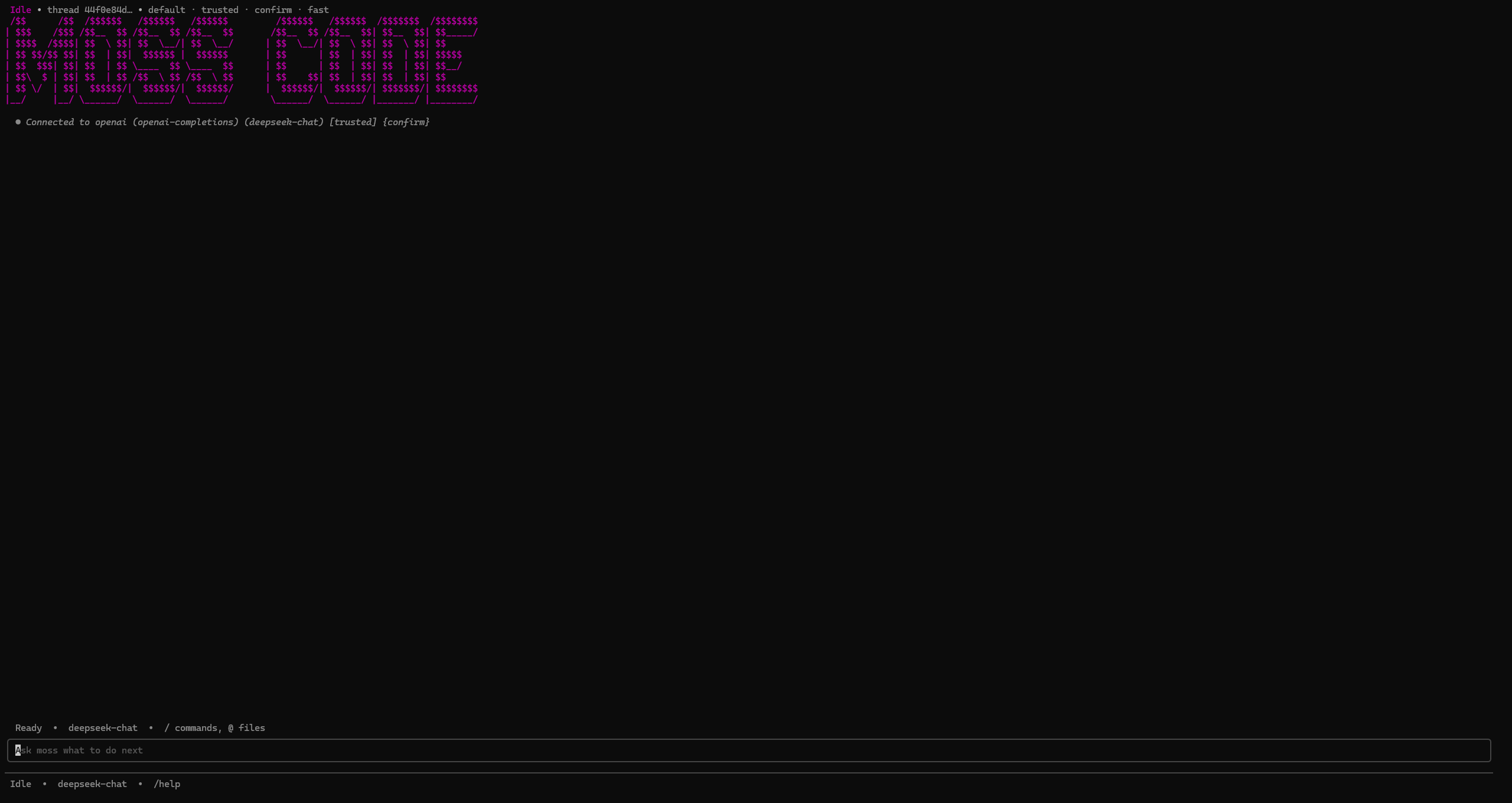 Core app
mosscode
The most complete coding-oriented product surface in the repository and the packaged moss CLI target.
Explore mosscode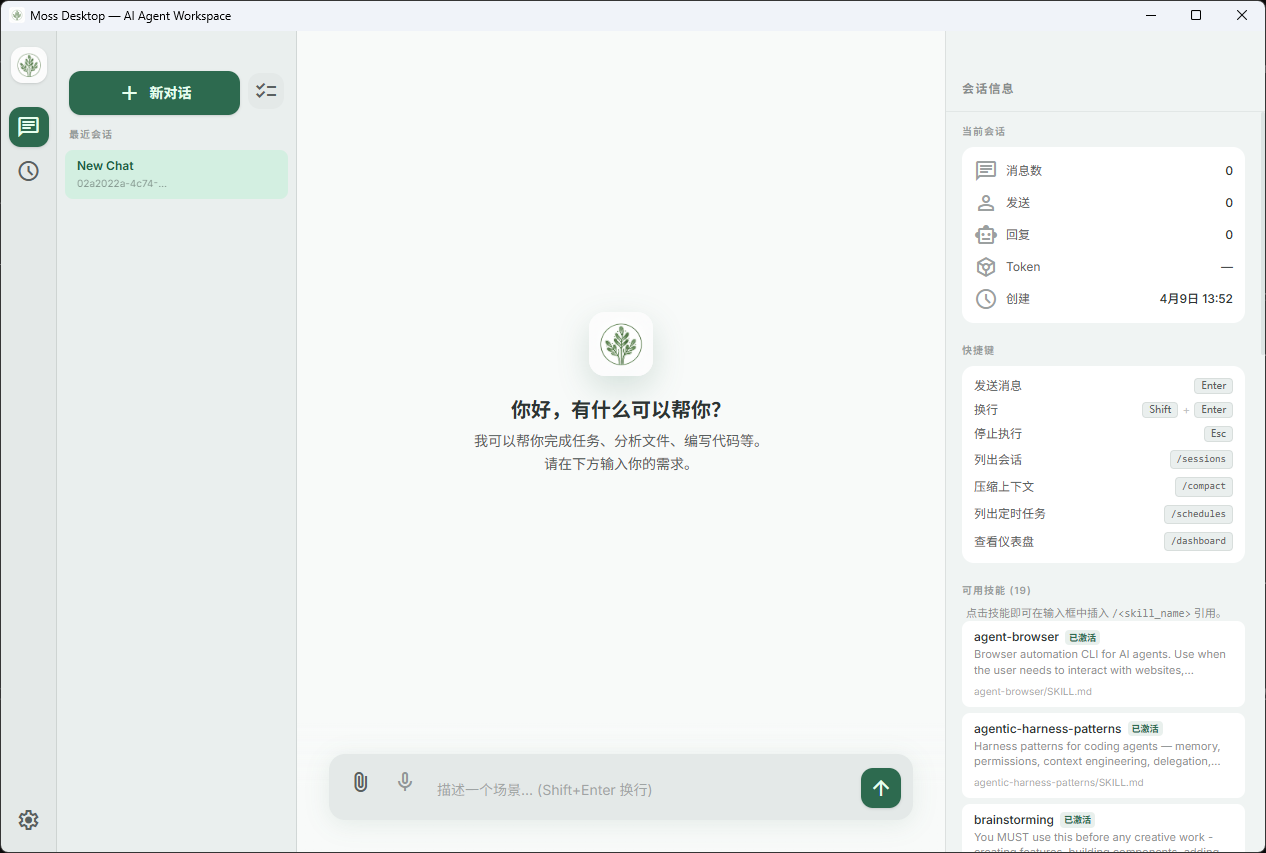 Core app
mosswork
Desktop collaboration surface built on the same runtime foundation and product assembly model.
Explore mossworkmossresearch
Research-oriented orchestration path that demonstrates evidence gathering and deeper delegated workflows.
Open mossresearchmosswriter
Writer-style product path that shows how workflow structure can be built above the same runtime layers.
Open mosswriterDocs
Use the homepage for orientation, then go deeper in the repo.
Keep the first read short, then route people into the right documentation path with language boundaries made explicit.
FAQ
Questions engineers ask before they commit.
The homepage should answer the framing questions quickly so readers know how to evaluate MOSS Agents.
What is MOSS Agents today?
MOSS Agents is a library-first Agentic Harness for Go with a reusable kernel, a configurable runtime assembly layer, core app surfaces under apps, and runnable examples under examples.
Who is MOSS Agents for?
MOSS Agents is aimed at engineering teams that want clearer runtime boundaries, extensibility, and a path from reusable runtime code into real agent products.
How does the runtime relate to apps and examples?
The runtime layers sit underneath the app surfaces. apps and examples are concrete entry points that prove how kernel, appkit, runtime loading, and presets show up in a working Agentic Harness.
Start with the repository
Evaluate the harness. Run a surface. Extend when it makes sense.
MOSS Agents is organized so teams can move from a minimal runtime foundation to deeper product surfaces without rewriting the whole system.